If you’ve ever felt like “self‑care” has turned into a marketing buzzword, go ahead and roll your eyes with me — because you’re not wrong. Somewhere along the way, the term got hijacked by marketing teams who would love for you to believe that the path to emotional wellness is paved with bubble baths, spa days, and $40 candles. Cute? Yes. Regulating? Not usually.
Real self‑care isn’t about treating yourself — it’s about taking care of yourself. A candlelit bubble bath is lovely, but it’s not the kind of care that actually helps your nervous system regulate, your relationships stabilize, or your mental health improve. Most of the things that genuinely support your brain, body, and nervous system don’t look cute on Instagram.
Functional self‑care is often quiet, mundane, and definitely not sexy. It’s boundaries. It’s rest. It’s saying no. It’s going to bed when you’re tired instead of doom‑scrolling until midnight. And honestly? Most of it feels more like maintenance than indulgence. It’s the stuff that doesn’t photograph well… but it’s also the stuff that supports your nervous system, strengthens your relationships, and keeps you functioning long‑term. Real self‑care changes everything.
Let’s break it down.
The Three Types of Self‑Care (That Actually Matter)
Most people think self‑care is one category: “treat yourself.”
Nope. It’s three very different layers, and you need all of them.
1. Foundational Self‑Care
This is the “keep your body alive and your brain online” tier.
It’s not glamorous. It’s not optional. It’s the stuff that makes everything else possible.
- Eating actual meals (protein counts, coffee doesn’t)
- Drinking water before your body sends an SOS
- Taking your meds on time
- Sleeping more than a raccoon in a dumpster
- Moving your body in ways that don’t feel like punishment
This is the self‑care equivalent of brushing your teeth. Not exciting — but absolutely essential.
2. Emotional Self‑Care
This is where things get tender — and where trauma survivors often struggle.
- Saying “no” without writing a 3‑paragraph apology
- Asking for help without shame
- Noticing your feelings instead of outrunning them
- Reducing overwhelm instead of powering through it
- Doing the Foundational stuff before you crash
This is the care that keeps your nervous system from living in a permanent state of exhaustion and burnout.
3. Restorative Self‑Care
This is the fun stuff — the joy, the creativity, the connection.
- Reading for pleasure
- Sitting in the sun
- Laughing with someone who gets you
- Doing something purely because it delights you
- Hobbies that don’t have to be monetized (radical, I know)
This is where you refill the tank, not just patch the leaks.
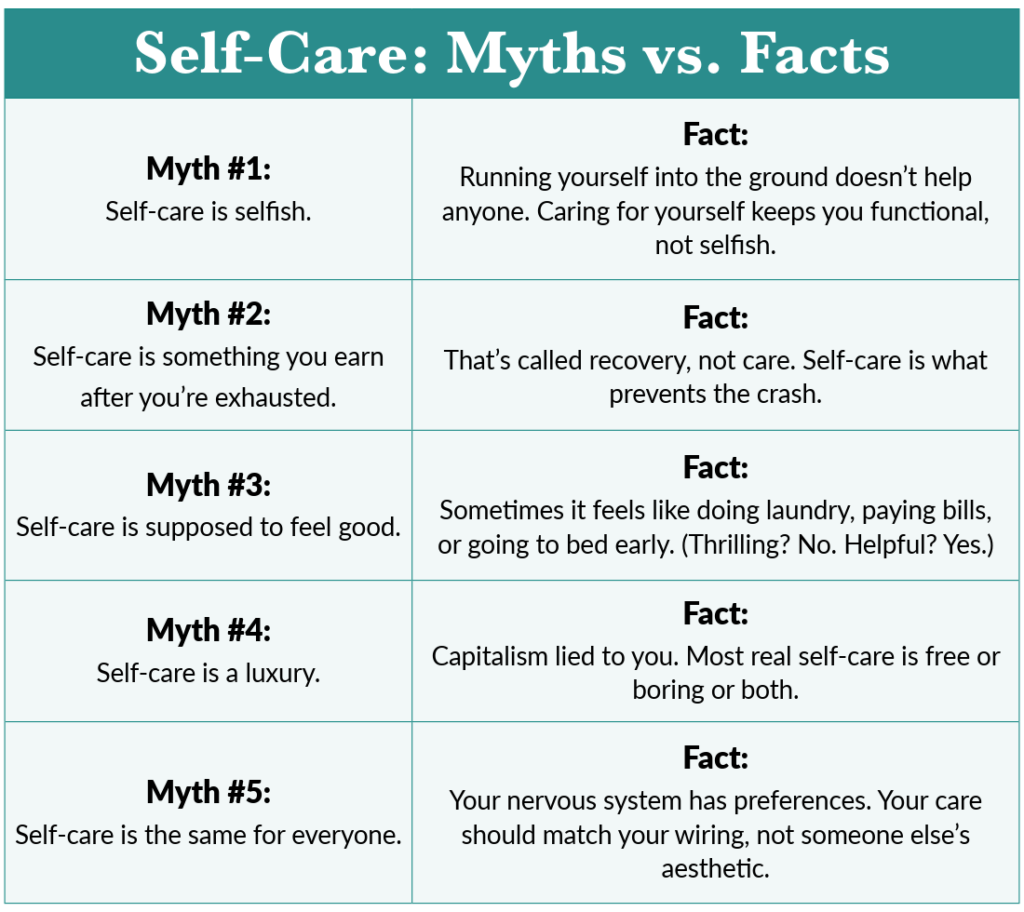
The Cultural Myths (and the Actual Facts)
Self-Care After Trauma
There’s also another layer worth naming — Trauma.
Trauma often teaches people to override their needs:

To push through.
To ignore signals.
To stay small.
To always be useful.
To collapse only when the system finally gives out.
If you’ve spent years (or decades) ignoring your body’s signals until they’re screaming, self‑care isn’t just a set of habits — it’s a skill set. One that wasn’t modeled, wasn’t safe, or wasn’t allowed. So the idea of self-care can feel confusing, indulgent, or even wrong. It’s not that you don’t want to take care of yourself, it’s that your nervous system learned that survival meant not doing these things.
That’s why foundational self‑care is often the hardest place to start. It requires noticing your needs, believing they matter, and trusting that responding to them won’t cost you connection, safety, or belonging. It’s not indulgence — it’s rehabilitation. It’s the slow, steady work of teaching your brain and body that you’re allowed to have needs and you’re allowed to meet them.
So when you ask a trauma survivor to “practice self‑care,” you’re not just asking them to take a bubble bath. You’re asking them to:
- Notice their needs
- Believe their needs matter
- Trust that meeting those needs is allowed
- Slow down enough to respond
That’s not indulgence. That’s nervous system rehabilitation.
And the beautiful part? Every small act of care — drinking water before you’re dehydrated, going to bed when you’re tired, saying no without apologizing — sends a quiet message to your nervous system: You matter. You’re safe. You’re allowed to rest now.
Foundational self‑care is often the hardest — and the most transformative — place to start.
The Rule of Three: The Bare‑Minimum Self‑Care Starter Pack
Here is a simple framework you can start doing today to begin rehabilitating your nervous system — no spa gift card required.
Body, Brain, Future You
Every day, choose:
1. One thing your body needs
Examples:
- A real meal — quality, not quantity
- A glass of water
- A 10‑minute walk
- A stretch that doesn’t feel like medieval torture
2. One thing your brain needs
Examples:
- A boundary
- A break
- A moment of quiet
- A thought that isn’t self‑criticism
3. One thing your future self will thank you for
Examples:
- Switching the laundry or folding “Mount Washmore”
- Sending the email
- Refilling your meds
- Going to bed when you’re tired
Functional self-care doesn’t require perfection — just presence and intention. Small choices, repeated consistently, create the kind of internal safety your nervous system can actually trust.
The Bottom Line
At the end of the day, self‑care isn’t a luxury — it’s a practice. A daily conversation between you and your nervous system. Some days it looks like binge‑watching the latest TV series. Some days it looks like paying bills before the late notices start rolling in. Some days it looks like doing the bare minimum and going to bed at 7 p.m. so you can try again tomorrow. And that’s enough.
Real self‑care isn’t about becoming a perfectly balanced human who drinks green juice and hits the gym five days a week. It’s about tending to yourself in small, consistent ways that remind your brain and body that you’re worth caring for. It’s choosing maintenance over meltdown, compassion over criticism, and presence over perfection.
You don’t need a full wellness routine. You don’t need a color‑coded planner. You don’t need a candlelit bathtub (though you’re absolutely welcome to keep that part). You just need a few simple practices, repeated with intention, that help you feel a little more human in a world that constantly asks you to be more than that.
Start small. Start messy. Start today.
Your nervous system will notice — and your future self will thank you.