Previous posts in the Raising Competent Adults series:
Raising Competent Adults: Kids Need to Fall Off the Monkey Bars
Raising Competent Adults: Emotional Respect
Parents often confuse discipline with punishment.
Punishment is fueled by the parent’s emotions — anger, frustration, etc. It says:
“You messed up, so now I’m going to make you suffer.”
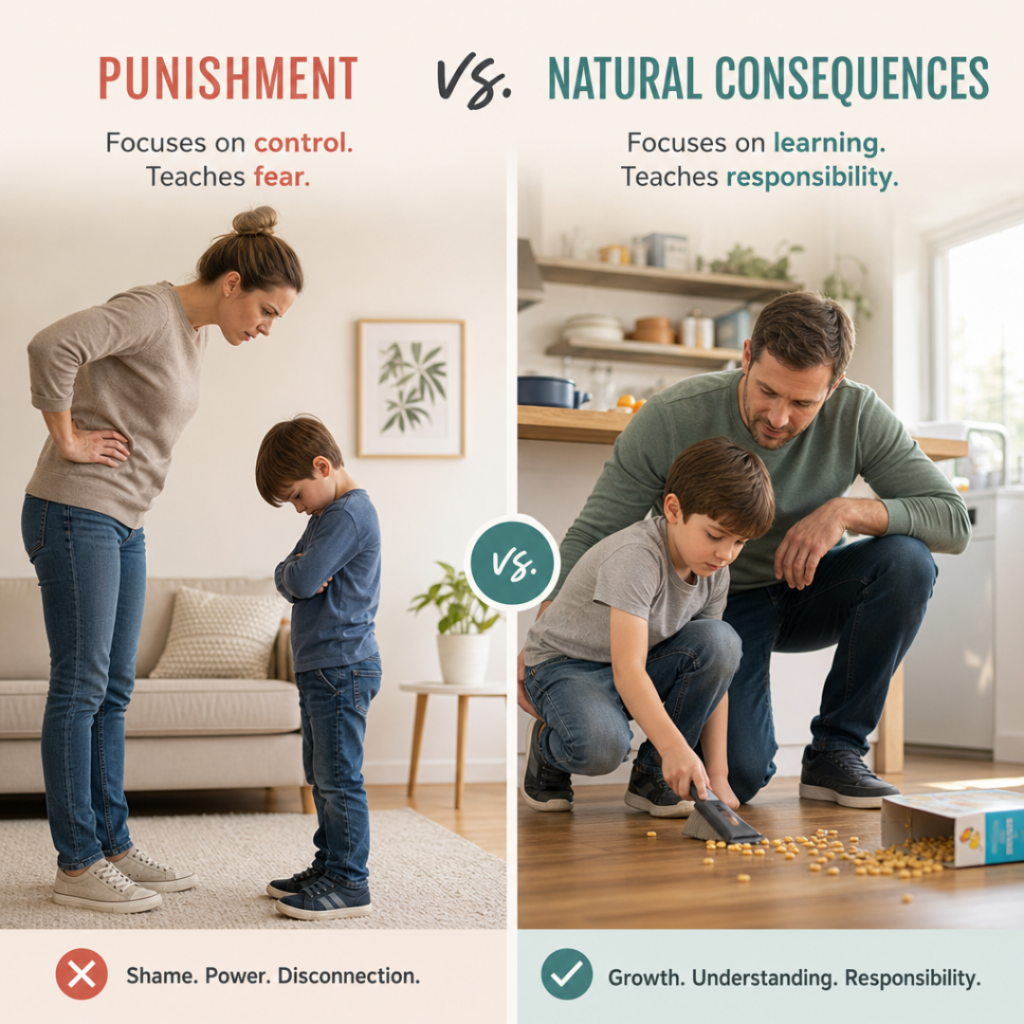
Punishment teaches:
- fear
- silence
- shame
- compliance
- avoidance
Punishment‑based parenting often produces adults with anxiety‑based procrastination, perfectionism, people‑pleasing, and chronic fear of making mistakes.
Discipline — actual discipline — is about teaching kids how the real world works, and the life skills they need to survive in it.
And nothing prepares a child for adulthood more effectively than natural consequences.
Natural consequences are focused on the child’s development. They say:
“You messed up, so now you get to learn how to fix it.”
Cause → Effect → Repair → Growth.
Natural consequences teach what punishment never can:
- accountability
- responsibility
- problem‑solving
- confidence
- resilience
- actual adulting skills
When you raise a child with natural consequences, you’re not raising a compliant kid — you’re raising a competent adult.
What Are Natural Consequences?
Natural consequences come down to one question:
“What would happen to me if I did the same thing?”
The answer to that question is what the child should experience.
Your job is to:
- Match the consequence to the behavior.
- Guide them through the process.
- Support without rescuing.
- Teach without shaming.
Natural, real‑world consequences start in toddlerhood — not adulthood.
But they need to be delivered with calm, empathy, and support, not anger, shame, or punishment energy.
Kids may be mad, embarrassed, overwhelmed, or upset that they have to fix their situation.
That’s okay. That’s human.
I feel that way too sometimes.
And yet… I still have to fix it.
Your job isn’t to remove the consequence. Your job is to remove the fear of making mistakes.
You show them:
- “I know this feels hard.”
- “I’m right here with you.”
- “You can do hard things.”
- “I believe in you.”
- “You did a great job handling that.”
This is how you raise kids who don’t crumble when life gets uncomfortable — kids who know how to navigate mistakes without spiraling into shame or avoidance.
Natural consequences teach the life lesson.
Compassion teaches the child how to grow from it.
Age‑Specific Examples
Below are examples across developmental stages — all rooted in natural consequences, all delivered with compassion.

Toddlers & Preschoolers
Potty Training: Bedwetting
Situation: Kid pees the bed.
Punishment: Spanking, shaming, scolding, “You’re too old for this,” or making them sleep in it.
Instead: Pause. Ask yourself, “What would happen if I wet the bed?”
I would have to clean it up, do laundry, and re‑make the bed. I certainly wouldn’t keep sleeping in it.
Natural consequence: They help clean it up, do laundry, and re‑make the bed.
So you say, “Uh oh! Your bed is wet. Let’s clean it up.” — Compassionate, calm, matter‑of‑fact.
You guide them through:
- pulling off the sheets
- dragging them to the washing machine
- putting detergent in
- moving everything to the dryer
- putting clean sheets back on the bed
They learn:
- accidents happen
- messes get cleaned
- how to do laundry
- how to make a bed
- confidence that they can do hard things.
Preschool & Early Elementary
The Checkout Candy
Situation: Kid pockets candy from the checkout line.
Punishment: Yelling, shaming, spanking, taking away toys, telling them “you could go to jail.”
Instead: Pause. Ask yourself, “What would happen if I stole candy?”
No one would spank me, and jail is unlikely — especially if I return it.
Natural consequence: They return the candy. (Even if it means driving all the way back to the store.)
You say, “Uh oh — this candy wasn’t paid for. We have to take it back.”
- You walk back inside together.
- You go to customer service.
- You help them explain what happened.
- You support them through the discomfort.
You stand beside them, not over them. The store employee will likely follow your lead, so it’s important to keep your tone even-handed.
They learn:
- accountability
- honesty
- impulse control
- repair
Elementary School

Forgot Their Lunch or Jacket
Situation: They forget their lunch or jacket even after reminders.
Punishment: Lectures, yelling, grounding, taking away screens.
Instead: Pause. Ask yourself, “What would happen if I forgot my lunch or jacket?”
I would be cold or hungry.
Natural consequence: They’re cold or hungry.
You don’t rescue them.
You don’t shame them.
You don’t say “I told you so.”
You simply say, “I bet that didn’t feel good. What can you do tomorrow to help yourself remember?”
They learn:
- planning
- responsibility
- self‑management
- natural motivation
Forgot Homework
Situation: They didn’t do their homework.
Punishment: Taking away devices, grounding, yelling.
Instead: Pause. Ask yourself, “What would happen if I didn’t do my job at work?”
I’d get a poor review — maybe fired if it was consistent.
No one is taking my phone away or telling me I can’t see my friends.
Natural consequence: You can’t fire a kid from third grade. But they get the grade they earned.
You don’t email the teacher.
You don’t fix it for them.
You don’t shame them.
You say, “I know that grade doesn’t feel great. What’s your plan for next time?”
You can suggest they ask the teacher if there’s a way to make it right — but the decision belongs to the teacher.
They learn:
- accountability
- time management
- consequences of inaction
- how to recover from mistakes
Teens

Crashed the Car
Situation: Scraped the car on a parking pillar.
(Yes — this one’s a true story.)
Punishment: Take the car away, grounding, taking video games away.
Instead: Pause. Ask yourself, “What would happen if I got into a fender bender?”
I’d have to get the car fixed. I might have higher insurance premiums.
No one is taking my car away or telling me I can’t see my friends.
Natural consequence: They have to get the car fixed.
So you guide them through the process:
- Sit with them while they call to make appointments for three estimates.
- Go with them to the first estimate — teach them what questions to ask, how to get the estimate in writing, how to read it. Play wing‑mom/dad for the next ones.
- Sit with them while they call insurance to learn the deductible and how a claim would affect their rates, so they can decide if they want to use insurance or pay for it themself.
- They pay for the repairs. (In our case, $3,000 paid back over six months — which meant working more and playing less.)
- They don’t have a car while it’s in the shop.
He walked away with real adulting skills:
- how to get repair estimates
- how to talk to professionals
- how car insurance works
- how to make financial decisions
- how to cut back on expenses to pay unexpected bills
Punishment would have taught him nothing.
Natural consequences taught him everything he needed to know when he hit a curb several months later.🤦♀️
(And yes, he handled it all by himself!)
Why Natural Consequences Work
Because they teach the child how the world actually works.
Punishment teaches how you work.
Natural consequences teach how life works.
Punishment creates fear.
Natural consequences create competence.
Punishment creates compliance.
Natural consequences create confidence.
Punishment creates perfectionism.
Natural consequences create resilience.
Punishment creates people‑pleasers.
Natural consequences create problem‑solvers.
This is how you raise competent adults.
Resources you may be interested in:
Parenting Counseling & Education
Teen Counseling
Teen Group Counseling