Most people think trauma is about “the past.” But trauma is really about what your brain and body are still doing right now — especially when something in the present feels even the tiniest (sometimes completely imperceptible) bit like the danger you survived. The amygdala doesn’t just flip the “danger switch.” It disrupts the entire network responsible for thinking, planning, regulating your body and emotions, and just generally feeling safe in the world.
If you haven’t read PTSD Breakdown – Part 1: You’re Not Crazy, go do that first. Because we’re going to break down what happens next. This post breaks down what actually happens inside the brain during trauma and why triggers can hijack your emotions, your body, your memory, and your ability to think clearly.
Revisiting the Amygdala & Prefrontal Cortex
The prefrontal cortex (PFC) is the part of the brain responsible for:
- emotion regulation
- problem‑solving
- working memory
- planning and organization
- impulse control
- attention
- social behavior
- decision‑making
Basically: the PFC is the part of you that makes thoughtful, rational choices. When you’re calm, the PFC is in charge. When you’re triggered, the PFC experiences a hostile takeover.
Why?
The amygdala — the brain’s danger detector — doesn’t care about logic. It isn’t looking for context — it’s looking for matches. Its job is survival, not accuracy. If anything even vaguely resembles the original danger — even subconsciously — the amygdala fires the alarm, and the PFC is no longer in charge of what happens next. You’ve literally “lost your mind,” because the brain is doing its job — prioritizing survival over thinking.
The Amygdala: Behind the Scenes
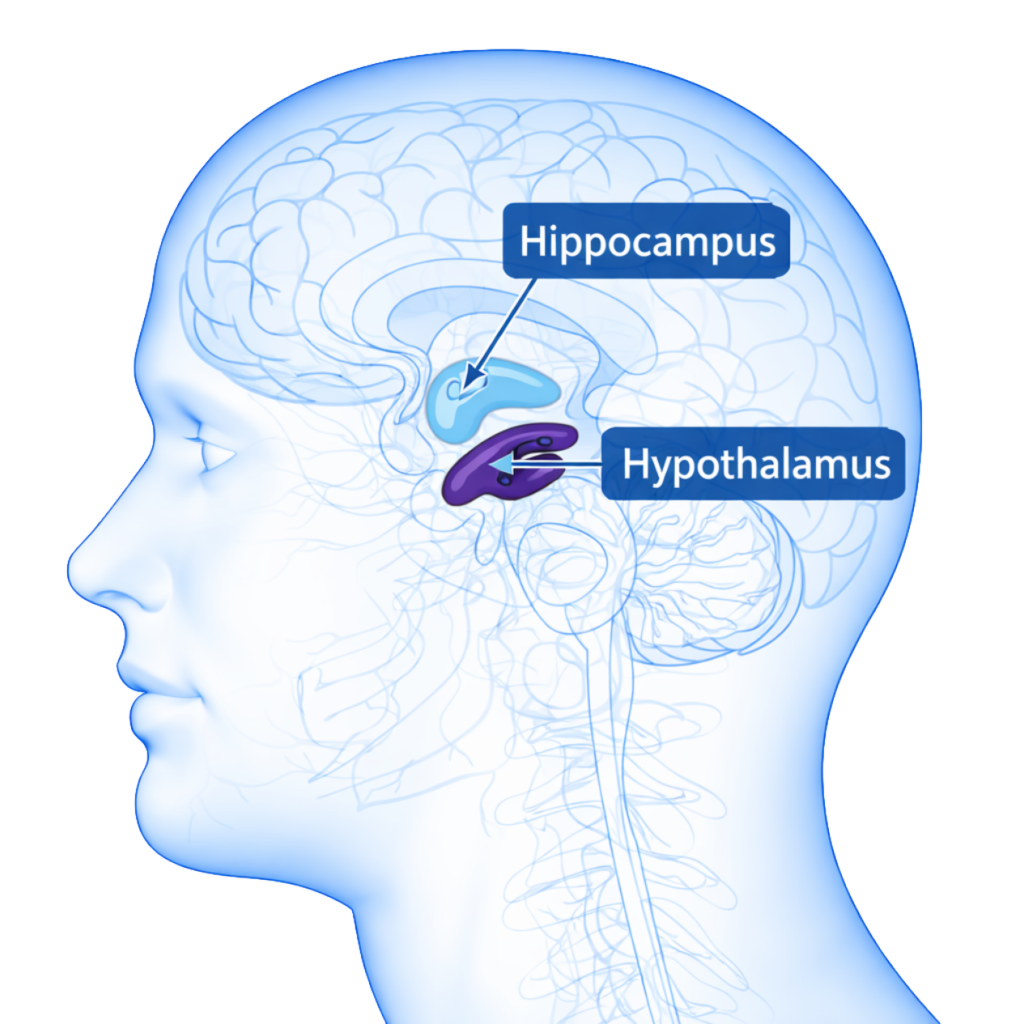
When there’s the slightest hint of a match, the amygdala goes to work. It sends a message to the hypothalamus, which controls your physical stress response:
The Hypothalamus: The Body’s Stress Switch
Trauma isn’t just “in your head.” It’s in your body. As the amygdala shuts down the PFC, it also sends a signal to the hypothalamus, which is responsible for initiating the physical stress response system. Your body reacts before you even know why.
- increased heart rate
- muscle tension
- shallow breathing
- stomach tightening
- sweating
- adrenaline & cortisol release
The Hippocampus: The Memory & Emotion Coordinator
The hippocampus is the part of the brain that:
- forms new memories
- organizes memories
- links emotions to memories
- helps you tell past from present
Let’s go back to the American Psychological Association’s definition of trauma:
Trauma is a deeply distressing or disturbing experience that overwhelms an individual’s ability to cope.
With the amygdala firing and the hypothalamus flooding the body with everything it needs to survive, the hippocampus can get overwhelmed. It can’t fully do its job before sending the “file” to the PFC, as it would with regular everyday events. This leads to two major problems:
Memories may be incomplete or fragmented
With they hippocampus being too overwhelmed to process the event, the person may have memories that are:
- fragmented
- blurry
- out of order
- missing
- stored as sensations instead of stories
- stored as emotions instead of words
Emotions from the trauma get re‑attached to present triggers
Have you ever met someone who is “overly sensitive” or just seems to always be in a bad mood?
When the hippocampus can’t file a memory away, the emotions just kinda float around, unprocessed and not knowing where to go. Then, when something in the present “triggers” a response from the amygdala, the hippocampus pulls up the unprocessed emotional file and applies it to the current moment.
This is why a small trigger can create a huge emotional reaction.
The Trigger Sequence: You’re not overreacting:
Trauma responses can be intense and feel like they come out of nowhere. Within 20-50 milliseconds:
Trigger → memory match (conscious or subconscious) → amygdala sends danger signal → prefrontal cortex goes offline → hypothalamus activates the stress response → hippocampus replays unprocessed emotions → cue trauma response
You’re not “overreacting.” The reaction isn’t happening in the thinking part of the brain. It’s happening in the survival system.
Conscious vs. Subconscious Trigger Examples
Conscious Example: Criticism → Perfectionism
Let’s say someone grew up in a home where mistakes were punished or shamed.
Now, as an adult:
- A boss’s tone
- A partner’s feedback
- A teacher’s comment
- A coworker’s raised eyebrow
…can trigger the same fear response they felt as a child.
The amygdala hears criticism and thinks: “Danger. You’re about to be rejected, punished, or humiliated.” The PFC shuts down. The hippocampus pulls up the old emotional file. And suddenly perfectionism feels like the only way to stay safe.
Subconscious Example: Holiday Decorations → Irritability
Subconscious trauma responses can be really confusing, yet they can also cause the most problems.
Someone might say:
- “The holidays just stress me out.”
- “I hate the holidays and I don’t know why.”
- “Everyone else is happy — why do I just want to crawl in a hole?”
If the trauma happened in late fall, things like holiday décor, music, the smell of pine trees, cold weather, certain foods, or even visiting family members can trigger the danger response — even if the person has zero conscious awareness of the connection.
Remember, the amygdala doesn’t care about context or accuracy. It cares about matches. Their prefrontal cortex is going offline. Their hypothalamus is firing the stress response (otherwise known as anxiety). And their hippocampus is pulling up old emotional files from something that happened when they were six.
So for the person who “hates the holidays,” it’s not that the festivities are overwhelming. It’s that their brain and body are overwhelmed. There is too much going on — not in the room, but in the nervous system.
How Trauma Gets Stuck — and What the Brain Needs to Heal
When something overwhelming happens, the brain tries to process the emotional memory and file it away so it can become part of your past instead of something you keep reliving. A large part of this processing happens during the dream stage of sleep called REM sleep. This is when the brain sorts, organizes, and “files” emotional experiences. Think of REM as the brain’s overnight clean‑up crew.
But when trauma is too intense or too much to handle at once, that clean‑up process gets disrupted.
- REM sleep becomes lighter or more fragmented
- nightmares increase
- the brain keeps trying to process the trauma but can’t finish the job
- the emotional charge stays high
- the memory stays “unfiled” and easily triggered
This is why so many trauma survivors have nightmares, restless sleep, or wake up exhausted — the brain is trying to integrate the experience but keeps getting stuck in the middle of the job. And this is exactly why therapies like EMDR, that mimic REM processing are so effective — but that’s another post.
Here’s the thing:
Trauma healing isn’t about “thinking differently.” You can’t out‑logic a survival system. You also can’t “positive mindset” your way out of a survival response. Healing requires:
- calming the amygdala so it stops firing false alarms
- re‑engaging the prefrontal cortex so you can think clearly again
- helping the hippocampus file the memory properly
- reducing the hypothalamus’s constant stress activation
- integrating the sensory, emotional, and memory networks so they work together
When these parts start working together again, triggers lose their power, and the past stops hijacking the present.
Pulling It All Together — A Real Life Example
I once worked with a woman who had been sexually assaulted on her college campus. She remembered pieces of the event, but not all of it — which is normal when the hippocampus is overwhelmed. What she did remember was the fear, the freeze, and the feeling of being trapped.
Fast‑forward a year. She came to therapy because she was having multiple panic attacks a day. She had to drop out of school and quit her job. She could barely leave the house. She was constantly on edge. She couldn’t function.
We decided to use EMDR to process what had happened to her. During one session, her brain finally connected the dots:
Her attacker was wearing a red shirt.
Okay — hold that. Because here’s where the amygdala’s sensory‑matching job becomes painfully clear.
This woman worked at Target.
Every. Single. Employee.
Every. Single. Shift.
Red shirts.
Everywhere.
The amygdala saw a red shirt → matched it to danger → fired the alarm → shut down her prefrontal cortex → activated her hypothalamus stress response (shaking, racing heart, difficulty breathing) → pulled up the unprocessed emotional file from her hippocampus → cue panic attack.
She wasn’t broken. Her brain was doing exactly what brains do: Protecting her.
The moment those dots came together, she cried — not because she was scared, but because she finally understood.
“I’m not crazy. My brain is trying to protect me. But I am safe now.”
That’s the moment trauma survivors exhale for the first time.