If you’re living with PTSD, you’ve probably had moments where you’ve thought:
- “Why am I like this?”
- “Why can’t I just get over it.”
- “Other people go through worse — what’s wrong with me?”
- “Why does my body freak out when nothing is happening.”
People with PTSD often think there’s something “wrong” with them. Your symptoms aren’t a character flaw. It isn’t a lack of self-control. It isn’t a failure to “move on.” Your seemingly irrational responses to situations are signs that you’re actually normal. Your symptoms mean that your brain is doing exactly what it’s supposed to do.
Once you understand what your brain is doing — and why — all of the questions above are answered. So let’s break it down:
The Two Key Players:
The Amygdala & Prefrontal Cortex
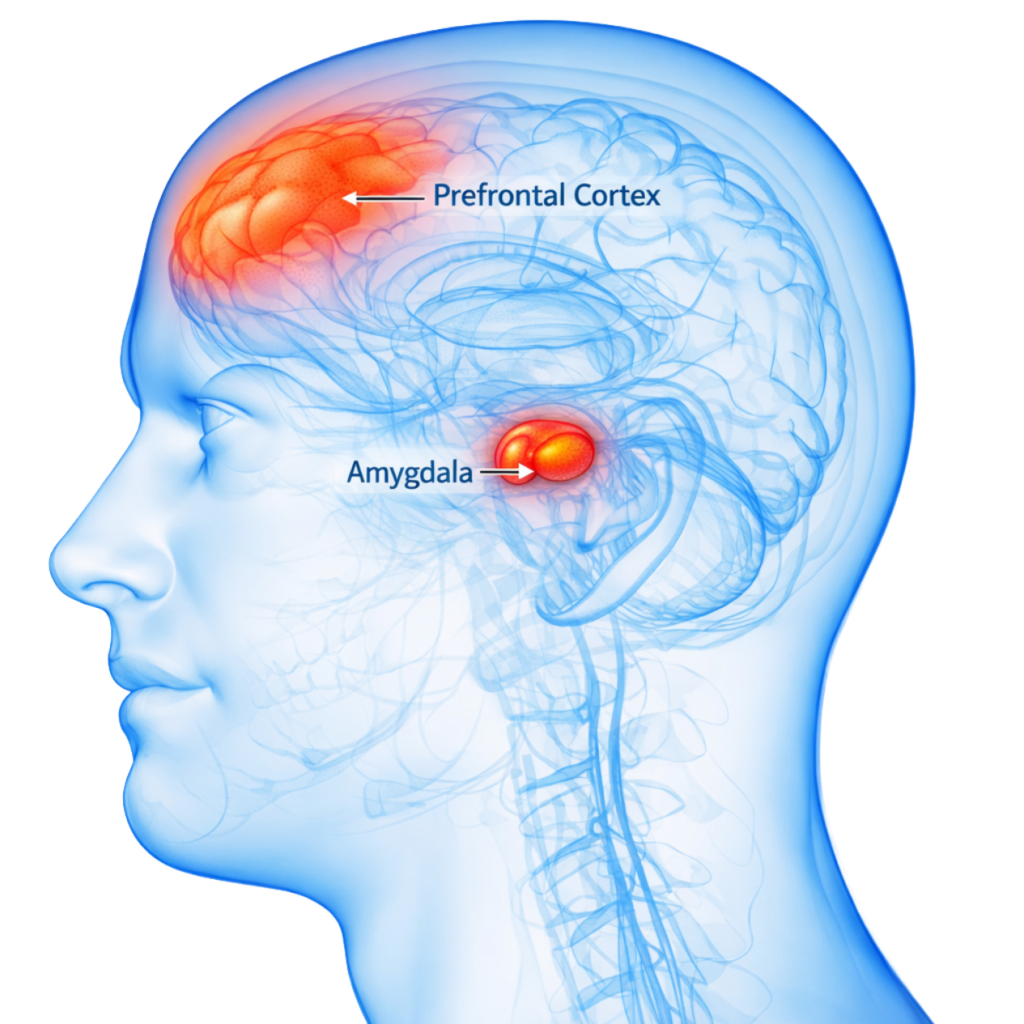
There are many parts of the brain, but PTSD really comes down to two:
The Amygdala — Your Internal Alarm System
Think of the amygdala as the “air‑traffic control tower” of your brain. It has one job: To keep you alive. It constantly scans your environment for anything that even resembles danger.
It does not care about nuance.
It does not care about context.
It does not care about your to‑do list, your relationships, or what’s for dinner.
It cares about survival.
Period.
The Prefrontal Cortex — The Thinking Brain
This is the “thinking” of your brain responsible for:
- logic
- decision‑making
- planning
- emotional regulation
- executive functioning
It’s the part that lets you “think before you act.” It is able to assess a situation, and make a reasonable, rational response. But there’s a catch: The prefrontal cortex is slow. The amygdala is fast. Lightening fast. And in a crisis, speed wins.
The amygdala — the “air traffic control” system — sees a plane in the airspace, and in about 20-50 milliseconds (roughly the speed of lightening), it sends off alarm bells before the prefrontal cortex can assess the situation and recognize that the plane is many miles away, and is not a threat.
No Time for Deep Thoughts
Imagine you’re taking a peaceful walk on a nature trail. Birds chirping. The sun is shining. All is well. Then…
You see a bear.
Are you going to stand there to weigh your options? Are you thinking about your grocery list? No! Are you trying to remember if you turned the stove off? Of course not! Because you aren’t thinking at all. When the amygdala senses danger, the prefrontal cortex — the rational, logical, “let’s think this through” part of your brain — goes offline.
Your amygdala saw a bear and did its one job. With lightening speed, it:
- shut down the prefrontal cortex (no time for thinking)
- flooded your body with adrenaline
- increased your heart rate
- redirected blood flow to your muscles
- heightened your senses
- unilaterally chose the best option for survival – fight, flight, or freeze
You don’t choose the response. Your amygdala chose survival. This is not a glitch in the system. It is not a system defect. This is your brain doing its job to keep you alive.
What is a trauma response?
Let’s start with the American Psychological Association’s definition of trauma:
Trauma is a deeply distressing or disturbing experience that overwhelms an individual’s ability to cope.
Trauma isn’t defined by the event — it’s defined by the nervous system’s response to the event. When the amygdala takes over, you might experience:
- tunnel vision
- racing heart
- shaking
- nausea
- sweating
- time slowing down or speeding up
- difficulty speaking
- difficulty thinking clearly
- feeling “checked out” or disconnected
This is not you “freaking out” for no good reason. This is your nervous system shifting into survival mode.
Facing down a bear? — Traumatic.
A violent event? — Traumatic.
A medical emergency? — Traumatic.
Growing up in a home where you never felt safe? — Traumatic.
Being chronically criticized, ignored, or shamed? — Traumatic.
Normally, when something small happens — like seeing a police car in your rearview mirror — your nervous system processes the event and moves along. Sure, you might get that adrenaline rush, quickly look down at your speedometer, and keep a close eye on the cop behind you. Fair enough. Your body may continue this response until the officer passes you or turns onto another road. At that point, your nervous system can re-regulate. You take a sigh of relief, your heartrate returns to normal, and you move on with your day.
“Trauma” happens when an event happens that exceeds your nervous system’s ability to re-regulate. The amygdala stays on high alert, ready to respond. This prevents the prefrontal cortex — the part that helps you make sense of what happened — from being able to fully process the event. Your nervous system doesn’t realize — the bear is gone. The cop is gone. You are safe. And for some, when trauma is chronic — like growing up in an abusive household — that air traffic control never slows down. This is PTSD.
Why you can’t “just move on”
Traumatic memories don’t get stored like normal memories. Normal memories get filed away neatly in the brain’s “story” section — with a beginning, middle, and end. Trauma memories get stored in the sensory part of the brain:
- images — like the color of the walls
- sounds — like a song that was playing on the radio
- smells — like a certain cologne
- body sensations — like your heart racing during a workout
- emotions — feeling criticized or abandoned
During a traumatic event the amygdala gets so overwhelmed that the prefrontal cortex is unable to fully process the event. It doesn’t feel like “something that happened.” Traumatic triggers tell the amygdala that it’s happening right now. Until the event can be processed — it’s unfinished business.
When the bear doesn’t go away
Let’s go back to our bear example.
Six months later, you’re at a child’s birthday party. One of the gifts is a teddy bear. It’s soft, cute, and harmless. Right? Sure — for someone that hasn’t been chased by a bear.
But your amygdala doesn’t see “cute.” It sees a bear‑shaped object and immediately pulls the fire alarm. With lightening speed, your body reacts as if the original threat is happening again:
- adrenaline surge
- racing heart
- panic
- urge to run or hide
You don’t think your way into this reaction — and you can’t think your way out of it. The prefrontal cortex is offline again. If it were online, it would say, “Oh, it’s just a stuffed animal,” and move on. But when trauma is unprocessed, the amygdala treats anything even vaguely similar to the original danger as a threat. Your amygdala is not trying to ruin your life. It’s trying to keep you alive. It would rather be wrong 1,000 times than miss danger once.
How Trauma Responses Show Up in Real Life
Most people understand “flight” — the urge to get the hell out of there. Because — a bear. But day-to-day fight and freeze responses can be harder to spot.
A trauma‑driven fight response can look like:
- snapping at someone over something small
- feeling instantly irritated or overwhelmed
- needing to defend yourself even when you’re not being attacked
- feeling a surge of anger you can’t explain or control
- talking fast, pacing, or feeling “amped up”
This isn’t you “overreacting.” It’s your nervous system responding to a perceived threat — even when there is no bear.
A freeze response can look like:
- going numb
- feeling stuck or paralyzed
- shutting down emotionally
- going quiet mid‑conversation
- feeling like you’re watching yourself from the outside
- losing the ability to speak or move
- feeling disconnected from your body
Just like a flight or fight response, a freeze response is not a choice. It’s not passivity. It’s not weakness. It’s your brain slamming the brakes because it believes escape is impossible. The amygdala has assessed that you cannot outrun the bear, so it’s time to hide, to make yourself small, or try to blend in with the environment in hopes the bear will go away.
“Why Can’t I Just Get Over It?”
This is one of the most painful questions people with PTSD ask themselves. The answer is actually quite simple: The prefrontal cortex — the logical part — is offline during a trigger. The amygdala — the survival part — is in charge.
You can’t out‑think adrenaline.
You can’t out‑reason a nervous system that is still trying to outrun a bear.
“Just calm down” is not an option.
Fight, flight, and freeze responses are automatic survival strategies, not personality traits. Because you can’t logic your way out of a survival response.
“I’m fine. It’s in the past.”
It’s easy to confuse “getting over it” with avoidance. Thinking about it, or doing things that remind you of the event (triggers) set of the alarm system. Naturally, we want to tuck it away and not think about it anymore. However, avoidance actually strengthens the alarm system. Every time you avoid a trigger, the amygdala learns: “Good job. Avoiding kept us alive. Let’s keep doing that.”
So you people-please to avoid conflict.
You work 80 hours a week to avoid other responsibilities
You procrastinate on small tasks
You’re too busy to socialize
Over time, your world gets smaller and smaller. You are not “fine.”
The Good News: Your Brain Is Normal
PTSD symptoms can affect every part of your life — relationships, work, school, parenting, sleep, and your sense of safety in the world. But the presence of these symptoms doesn’t mean you’re broken. In fact, quite the opposite is true. It means:
- your amygdala is doing its job
- your brain is trying to protect you
- the traumatic memory hasn’t been fully processed
- your prefrontal cortex can’t come online when you need it
You’re not “crazy.” You’re having a normal biological response to an abnormal experience. Your brain is doing a great job at protecting you and keeping you alive. It just needs a little help turning the alarm system off.
And here’s the cool part: The brain can rewire. Neuro-based therapies — including EMDR, biofeedback, and somatic (body-based) therapies — worth directly with the amygdala to help the brain reconnect the amygdala and the prefrontal cortex so the memory can finally be filed away as “over.”
The bear goes away. You can breathe again.
Curious what happens next? Check out PTSD Breakdown – Part 2: You’re not overreacting