In the last post, we talked about how “fine” isn’t an emotion“ — it’s a placeholder.
It’s a decoy.
It’s a socially acceptable way to avoid saying what’s actually happening inside your nervous system.
Now let’s talk about the other placeholder people use constantly:
“I’m tired.”
Ask someone how they’re doing, and you’ll hear it everywhere:

“I’m tired.”
“So tired.”
“Just… tired.”
“Beyond tired.”
“Tired in my soul.”
And sure — sometimes tired is just tired. You didn’t sleep well. You’re stretched thin. Your kid woke you up at 4 a.m. to announce that the cat threw up on the stairs.
But most of the time?
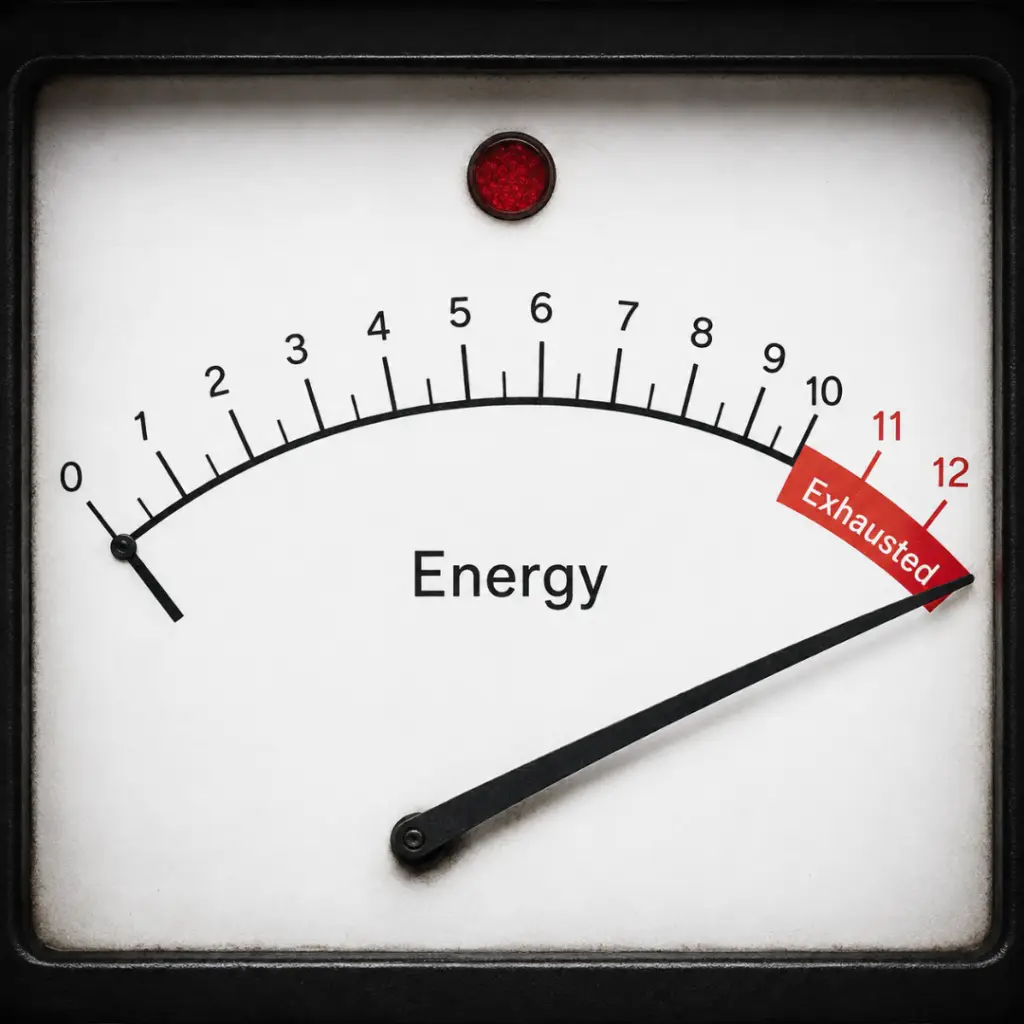
“Tired” is code for “my nervous system has been stuck on 12 for so long that exhaustion is the only language it has left.”
Your Nervous System Has a Volume Dial —
And Many People Are Stuck at Max Volume
In PTSD Part 1, we talked about how the nervous system gets stuck in fight, flight, or freeze.
In PTSD Part 2, we talked about how chronic anxiety is basically your body living in a perpetual state of “danger until proven otherwise.”
Here’s the thing no one tells you:
Living in fight/flight/freeze is exhausting.
Not “I need a nap” exhausting.
Not “I stayed up too late” exhausting.
Not “I should drink more water” exhausting.
I mean bone‑deep, soul‑heavy, brain‑fog, can’t‑turn‑off, why‑am‑I-like-this exhaustion.
The kind of exhaustion that sleep doesn’t fix.
The kind of exhaustion that rest doesn’t touch.
The kind of exhaustion that makes you say “I’m tired” because you don’t have the emotional vocabulary — or the emotional permission — to say:
“I’m overwhelmed.”
“I’m anxious.”
“I’m scared.”
“I’m burnt out.”
“I’m carrying too much.”
“I’m shutting down.”
“I’m stuck in survival mode.”
Just like “fine,” “tired” isn’t a feeling.
It’s a state.
A signal.
A symptom.
Why Chronic Anxiety Feels Like Chronic Fatigue
Maybe you’ve lived through enough unpredictable or frightening experiences that your brain has learned:
“We’d better stay ready.”
So you do.
Even when nothing is happening.
Even when you’re sitting on the couch.
Even when you’re technically “relaxing.”
Your body may still be working overtime by repeatedly spending energy preparing for danger, even when there isn’t an immediate physical threat.
When your body is stuck in fight/flight/freeze, that preparation has a physiological cost:
- your heart rate stays elevated
- your muscles stay tense
- your breathing stays shallow
- your brain stays hypervigilant
- your cortisol stays high
- your sleep becomes light, fragmented, or non‑restorative
- your digestion slows
- your immune system shifts
- your energy gets rerouted toward “survival tasks”
This is what I mean when I say your nervous system is “on 12.”
It’s like leaving every light on in your house, every appliance running, every burner on the stove turned up, and then wondering why the power bill is astronomical.
Your body is burning energy like you’re sprinting — even when you’re sitting still.
Of course you’re tired.
Tired vs. Tired vs. Tired
There are three different types of “tired,” and it’s important to recognize which kind(s) you are experiencing.
1. Physically Tired
You didn’t sleep.
You’re dehydrated.
You’re iron‑deficient.
Your toddler wet the bed four times last night.
You’re human.
Note: If you are chronically tired, talk to your doctor to see if there may be something medical going on.
2. Emotionally Tired
You’re carrying feelings you haven’t named.
You’re doing the emotional labor of three people.
You’re spending all of your unallocated energy pretending you’re fine.
3. Nervous System Tired
This is the chronic anxiety version.
This is the “I could sleep for 10 hours and still wake up exhausted” kind of tired.
This is the version people mistake for laziness, procrastination, or lack of motivation — when sometimes, it’s physiological overload.
When “Tired” is a Nervous System Symptom
When your nervous system is stuck in survival mode, your body doesn’t say:
“I’m dysregulated.”
“I’m overwhelmed.”
“I’m in a chronic anxiety.”
It says:
“I’m tired.”
Because fatigue is the socially acceptable version of “I’m not okay.”
It’s the version you can say at work.
It’s the version you can say to your partner.
It’s the version you can say in the grocery store checkout line.
It’s the emotional equivalent of putting a blanket over a mess and hoping no one lifts it.

When “Tired” Is Actually Fight Mode
You feel wired, restless, irritable, snappy.
Your brain won’t shut up. (This can make it difficult to sleep.)
Your body feels like it’s buzzing.
When “Tired” Is Actually Flight Mode
You feel overwhelmed, avoidant, scattered.
You can’t focus.
Everything feels like “too much.”
When “Tired” Is Actually Freeze Mode
You feel heavy, numb, foggy.
You can’t get started.
You’re exhausted before you begin.
All three can look like “tired.”
But underneath the tiredness, something else may be happening.
Dysregulation.
Chronic Anxiety Doesn’t Even Feel Like Anxiety Anymore
This is one of the sneaky things about living in survival mode for a long time.
You may not walk around thinking: “I am experiencing chronic anxiety.”
You may just think:
I’m tired.
I’m overwhelmed.
I can’t concentrate.
Everything feels like too much.
I don’t want to deal with anybody.
I just need everyone to leave me alone.
Why do I have no energy?
Why can’t I get motivated?
And sometimes the answer is:
Because you’ve been running on high alert for a very, very long time.
This is your “normal.”
Your body doesn’t necessarily experience that as a dramatic panic attack.
Sometimes chronic anxiety looks like irritability.
Sometimes it looks like restlessness.
Sometimes it looks like brain fog.
Sometimes it looks like difficulty sleeping.

And sometimes it looks like being completely freaking exhausted.
You don’t even notice the anxiety anymore.
Because you feel “normal.”
But “normal” doesn’t mean regulated.
Your body knows the difference.
Anxiety and Depression Can Overlap
Chronic anxiety takes a tremendous amount of energy.
If your brain is constantly scanning for danger, anticipating problems, and preparing for what might go wrong, eventually you may simply run out of gas.
And when you’re exhausted for long enough, your world can start to get smaller.
You don’t have the energy to do the things you used to enjoy.
You don’t have the energy to solve the problems in front of you.
You don’t have the energy to keep fighting the same battles.
And eventually, exhaustion can start turning into: “What’s the point?”
Anxiety doesn’t automatically cause depression, but living in chronic anxiety can absolutely contribute to the exhaustion, withdrawal, and helplessness that often accompany depression.
Sometimes anxiety says: “Something bad is going to happen.”
And after living with that long enough, depression can start saying: “It doesn’t matter. I can’t do anything about it anyway.”
Cue depression.
What Kind of Tired Are You?
The next time you find yourself saying “I’m tired,”
Pause for a minute.
Ask yourself:
What kind of tired am I?
Am I sleepy?
Physically exhausted?
Mentally exhausted?
Emotionally exhausted?
Overstimulated?
Burned out?
Disconnected?
Or have I been running on adrenaline for so long that I don’t even remember what not being tired feels like?

The Real Question Isn’t “Why Am I Tired?”
Maybe the question isn’t just “Why am I so tired all the time?”
Sometimes “tired” is your body’s way of saying “I’ve been working really hard to keep you safe.”
Maybe the real question is
“What has my nervous system been working so hard to protect me from?”
Your exhaustion isn’t a failure.
It’s evidence.
Your body has been carrying a story your mind hasn’t had the safety to tell yet.
And now it’s asking you to listen.